
When a Brand Has a Body, It Needs Physics
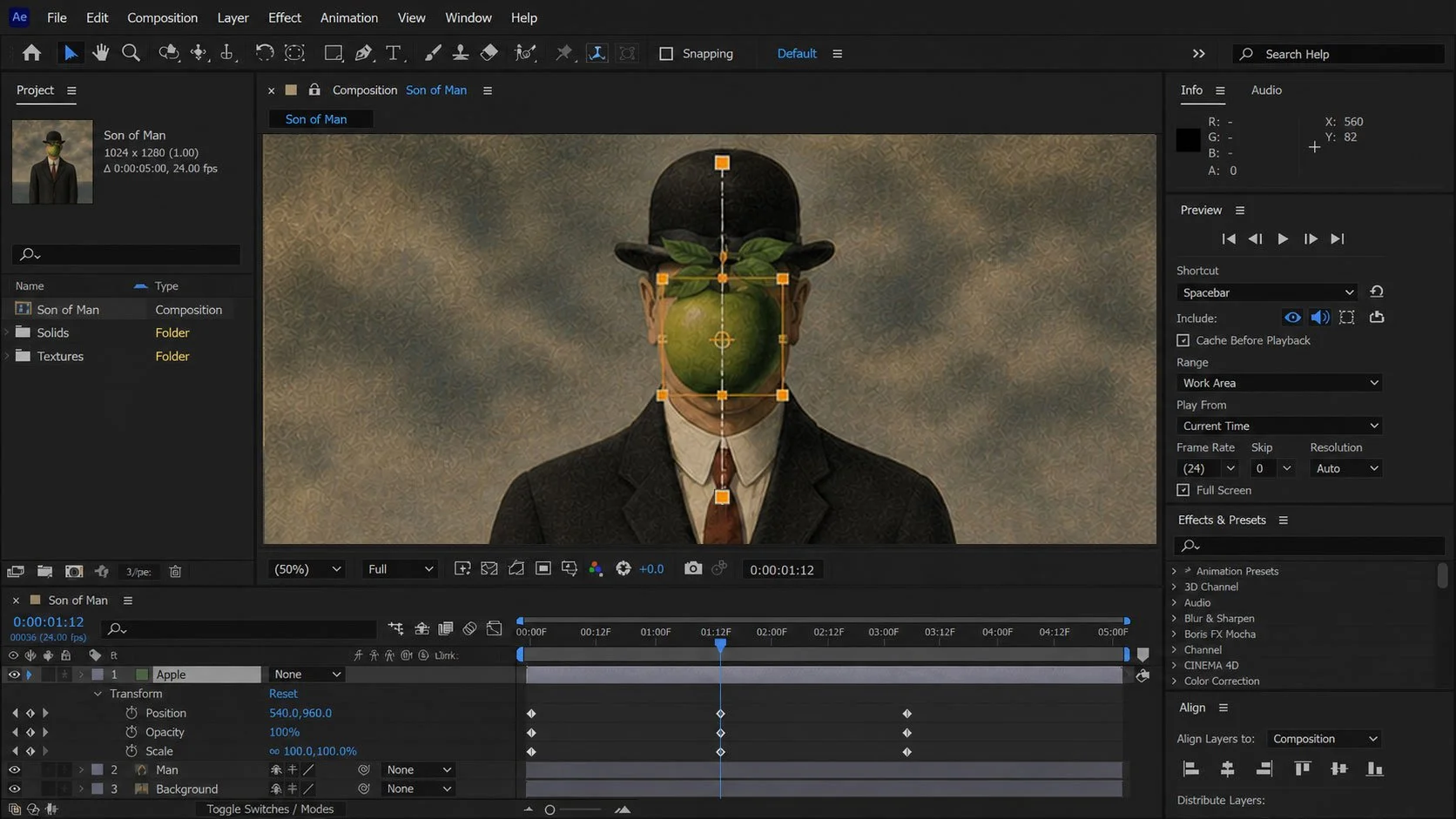
A conversation with René Magritte, The Son of Man (1964) — because some ideas were always meant to be animated
Why the brands that move best don't start with feelings — they start with forces.
Magritte's apple has always bothered me. Not because it hides a face. But because it just… floats there. No gravity. No trajectory. No physics. It exists outside the rules that govern everything else that moves.
For a long time, I thought that was the point. Surrealism defying logic.
Then I started working with brands in motion — and I realised that most of them move exactly like that Apple. Suspended. Arbitrary. Beautiful, maybe. But answering to nothing.
That's what I wanted to fix.
Newton didn't invent gravity. He just noticed it had rules. Before the apple fell, the forces were already there — mass, acceleration, the arc of the trajectory. Invisible until something moved.
Your brand is no different. The forces are always present. Most teams just never bother to name them. And when they don't, everyone invents their own version of "dynamic" — and the brand moves in ten different directions at once.
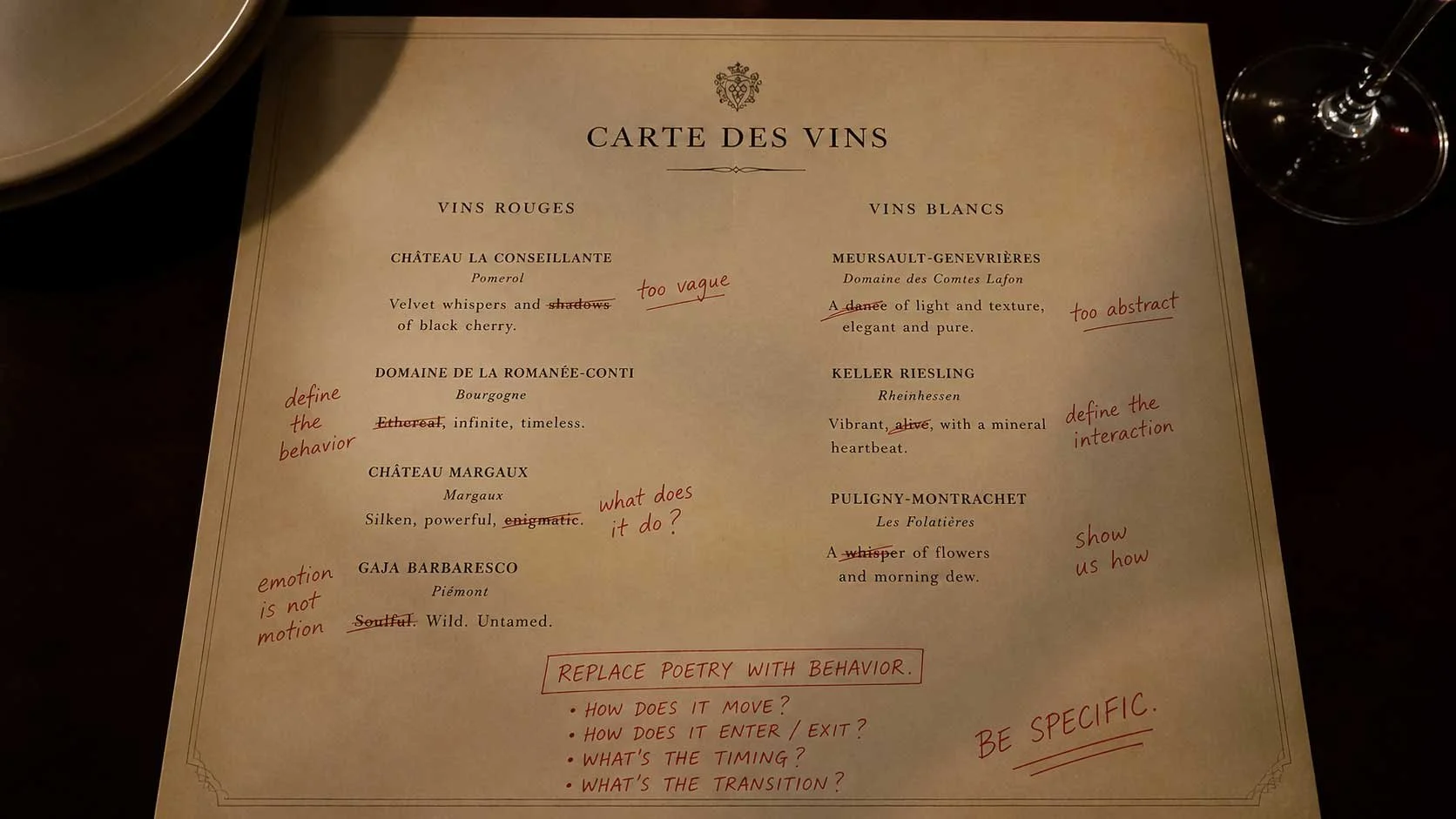
Emotion is not Motion.
The problem with adjectives
Most brands describe how they want to move the same way people describe wine.
Dynamic. Fluid. Bold. Warm.
And just like wine descriptions, everyone nods — and everyone pictures something slightly different. The motion designer sees fast cuts and kinetic energy. The brand manager sees smooth transitions and elegance. The UX team sees responsive micro-interactions. All of them are technically right. None of them are making the same thing.
This isn't a failure of creativity. It's a failure of language.
Adjectives describe impressions. What is needed is something more precise: a description of behaviour. Not how something feels, but what it physically does — how it initiates, how it travels, how it arrives, how it reacts.
"Velvet whispers" doesn't tell a motion designer anything. "Slow opacity fade, soft scale up, 200ms delay, no overshoot" tells them everything. The difference between those two descriptions is the difference between a brand that moves consistently and one that moves hopefully.
That's where physics comes in.
Movement is physical before it's aesthetic
When something moves, it doesn't move because it "feels energetic." It moves because forces act on it — weight, resistance, energy building and releasing.
We don't consciously register these forces. But we feel them instantly. And the brain reads motion physics before it reads content. Before your message lands, the movement has already told the user something about your brand — whether it's confident or hesitant, precise or playful, heavy or weightless.
A brand without defined motion physics isn't neutral. It's just unpredictable.
The five forces behind brand behaviour

Emotion is not Motion.
Every brand, when it moves, expresses five fundamental physical properties — whether it knows it or not. Naming them is the first step toward controlling them.
Mass is perceived weight — how much gravity a brand carries when it moves. A brand with high mass doesn't stop, it lands. A brand with low mass glides, hovers, disappears before you noticed it arrive. Think Goldman Sachs versus Spotify. One settles with authority. The other floats through.
Elasticity is how a brand reacts to force. Does it arrive with precision — no deformation, no overshoot? Or does it absorb the impact, deform slightly, and recover? One says engineered. The other says alive. Neither is wrong — but they're definitely not the same brief. A brand that claims precision but moves with elasticity creates a contradiction users feel before they can name it.
Friction is what the space feels like to move through. Zero friction: effortless, perpetual slide. High friction: deliberate, every frame earned. Most teams obsess over speed. Almost none ask what the environment feels like. (Spoiler: it matters.)
Tension / Tempo is the relationship between movement and silence. Tempo is the heartbeat. Tension is everything that happens before it beats. Two brands can move at identical speed and feel completely different — because one pauses before it moves, and the other doesn't.
Directionality is a spatial instinct. Does the brand pull toward a center? Project outward? Move in a straight line or propagate in curves? It's where the brand goes when no one tells it where to go — and one of the clearest expressions of personality in motion.
Why these five forces matter together
None of these forces works in isolation. A brand with high mass and zero friction creates a strange contradiction — heavy, but frictionless, like a boulder on ice. (We've all seen that brand. We've all worked on that brand.) A brand with explosive tempo and concentric directionality feels like an implosion. The forces need to be calibrated against each other, and against the brand's purpose.
That calibration is what separates brands that look consistent from brands that feel consistent. Visual consistency — same colors, same fonts, same logo — is relatively easy to achieve. Behavioral consistency — the brand moving with the same physical logic across every format, every touchpoint, every context — is much harder. And much more valuable.
Because visual consistency can be copied. Behavioral consistency can't.
From physics to purpose
Defining these five forces gives a brand something most identities never have: a physical grammar. A shared language that any designer, animator, or UX team can read and execute consistently — without a 40-page manual, without a reference call, without guesswork.
But physics is an instrument, not a composer. It describes how a brand moves with extraordinary precision. What it doesn't yet tell you is why — what the movement is ultimately in service of.
That's the role of the Motion Driver: the strategic layer that conducts the physics toward a specific brand behaviour. Together, they form a complete system — one where every frame carries intention, and every transition reinforces something true about the brand.
In the next post, we'll unpack exactly what a Motion Driver is — and how it transforms five calibrated physical forces into a coherent, scalable brand identity.
