
Living Expression: The First Step Toward a Living Identity
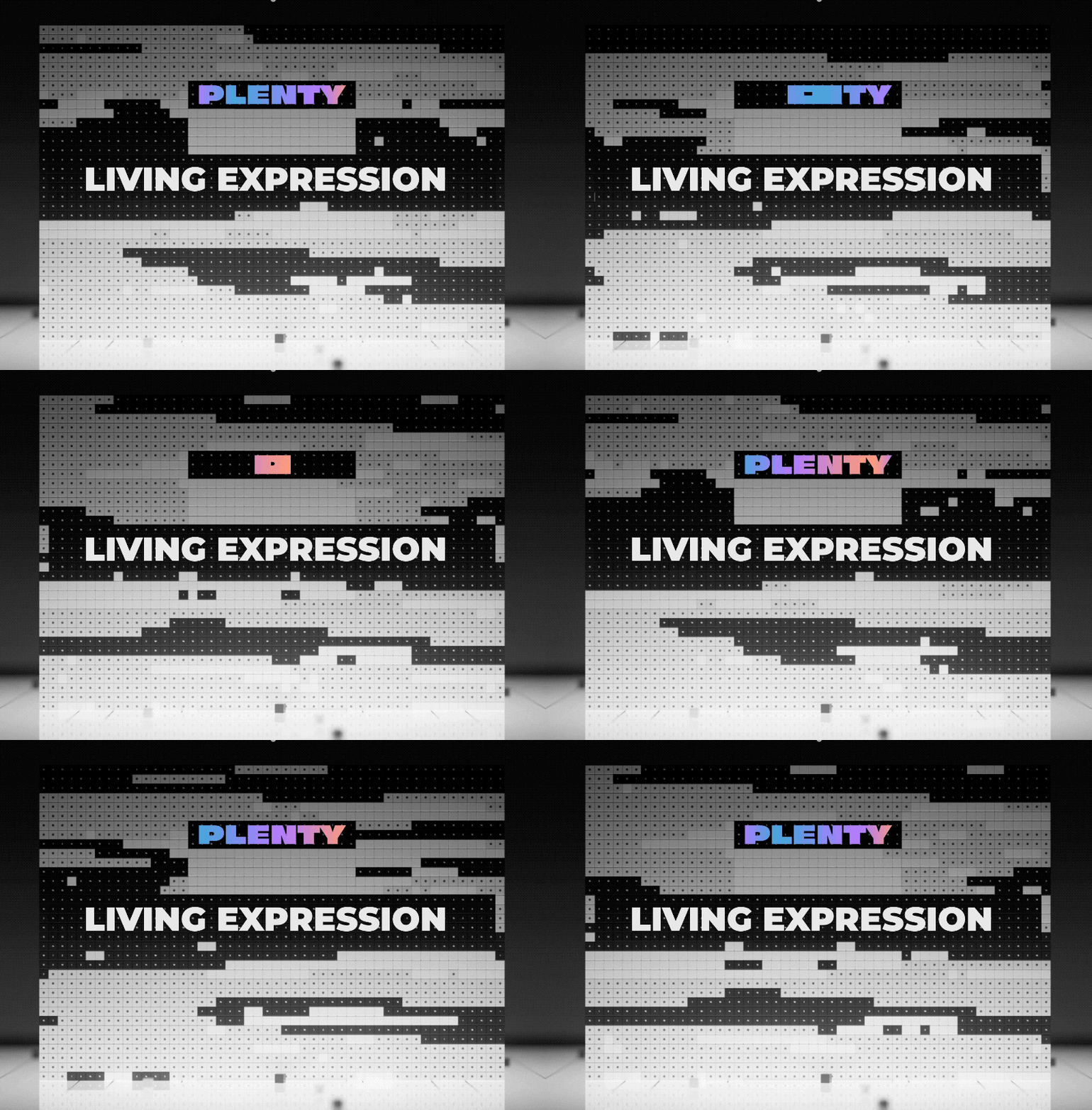
Motion is no longer just aesthetic. It’s brand value in real time.
In my previous post, I highlighted a painful reality: traditional Motion Manuals often fail because they offer abstract "vibes" rather than actionable behavior. We identified the symptom. Now, let’s talk about the solution.
Today, brands aren't just competing for attention. They are competing for recognition, recall, and consistency in environments that change constantly.
Every interaction on a screen — a feed, a retail display, an interface, a car dashboard — is an opportunity to reinforce or dilute brand value. In this context, motion is no longer decorative; it has become a direct driver of brand performance.
Screens are everywhere. Visual behaviour now shapes how fast a brand is recognised and how clearly it is understood. Yet, many brand systems are still designed as if this environment didn’t exist.
The problem isn’t that brands don’t move. The problem is how — and when — that movement is decided.
When motion comes too late, the system breaks
In most branding processes, motion still arrives at the end. First, the “formal” identity is defined: logo, typography, visual system. Only afterwards does the question of animation appear.
Over the last few years, Motion Principles have become standard practice. When well designed, they help: they bring order, consistency, and reduce operational noise.
Motion itself isn’t the issue. The issue is that it tries to fix decisions that were already locked in.
The outcome is familiar to anyone who has led a large brand:
Rigid visual systems that later need to “feel” flexible.
Animations that rely on individual talent rather than the system.
Constant friction between design, marketing, and external partners.
Difficulty scaling and delegating.
An uncomfortable question inevitably arises: If the brand needed to communicate agility or adaptability, why was it designed as a rigid system in the first place?
Living Expression: Changing the order of the decision
A Living Expression is not a creative asset, nor a style of animation. It is a strategic decision made before design.
It defines what the brand does when it meets people: how it appears, how it activates, how it responds across contexts. It doesn’t describe how a logo moves; it defines what the brand generates through movement.
When this decision is made at the start of the process, the impact is structural:
Design doesn’t “tolerate” motion — it is born ready for it.
Rules are not forced — they emerge naturally.
The system becomes easier to govern and easier to scale.
You don’t animate a finished form. You design a form with latent motion.
A simple example
Imagine a brand whose core promise is to fulfill something instantly.
With the traditional approach:
A static visual system is designed.
Motion rules are added later (fast entrances, agile transitions).
Motion merely “supports” a promise that was already defined.
With a Living Expression:
The brand is defined from the start as something that materialises what it promises.
Elements don’t simply “appear” — they assemble, converge, and complete.
Proportions, grids, and layouts are designed around that behaviour.
The result isn’t just more coherent animation. It’s a system that reinforces the brand promise in every interaction, even when the logo isn’t present.
That is Living Expression: Not how the brand moves, but what it does when it moves.
Two approaches, two very different systems
Traditional approach
Design decisions come first.
Motion adapts afterwards.
Consistency depends on effort.
Living Expression
Behaviour is defined first.
Design is born aligned.
The system scales with less friction.
The difference isn’t aesthetic. It’s strategic, operational, and organisational.
The moment is now
Brands already live in motion, even if many systems aren’t prepared for it. When the system doesn’t keep up, the cost shows up — in time, in decisions, and in coherence.
Defining a Living Expression isn’t creative sophistication. It’s a clearer way to translate brand value into visible, consistent behaviour.
A brand that lives in motion shouldn’t be born static and animated later.
It should be born alive.
